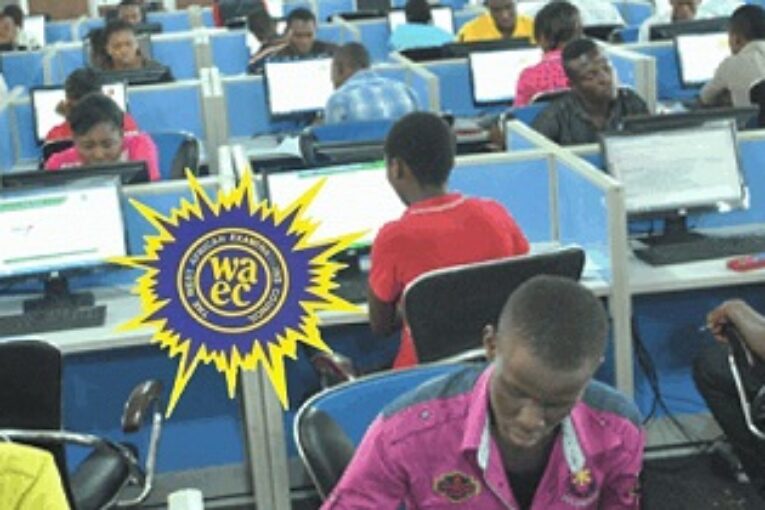
The Senior Secondary School Certificate exam, conducted by the West African Examinations Council (WAEC), is held in Ghana, Sierra Leone, Liberia, The Gambia, and Nigeria. WAEC announced plans to shift from traditional paper-and-pencil tests to Computer-Based Testing (CBT) for Nigeria’s 2026 West African Senior School Certificate Examination (WASSCE), affecting about two million students across 23,554 schools.
The rollout begins with this year’s edition, tentatively scheduled from 24 April to 20 June 2026, with the aim of improving integrity, reducing malpractice and ensuring results are released 45 days after the exam, with digital certificates available within 90 days.
WAEC’s Head in Nigeria, Amos Dangut, revealed that 1,973,253 students will participate, covering 74 subjects and 196 papers. According to him, the digital exams will feature unique question papers for each of the candidates as part of efforts to uphold academic integrity.
To support students, the examination body says it has introduced digital learning tools like the WAEC E-Study Portal, E-Learning Portal, and WAEC Konnect. These platforms offer past questions, marking schemes, and performance analysis.
Despite all this fine promises thousands of students across Nigeria are apprehensive. While the shift toward digitalisation is a progressive move intended to curb examination malpractice and speed up the release of results, the infrastructure on the ground tells a different story.
In many suburban and rural schools, the “digital revolution” feels like an ancient myth. It was only last year Nigeria crossed the 50 per cent broadband penetration mark, according to data from the Nigerian Communications Commission (NCC) under the National Broadband Plan (NBP) 2020–2025.
But the substance of the matter is, can schools that lack the ability to purchase electric bulbs to lighten classrooms build rooms and stock them with computers before this year’s test commences?
The House of Representatives got wind of this development in early November and asked WAEC to halt, citing concerns that it could lead to massive failure and disadvantage students in rural areas with limited access to computers and the internet. The lawmakers suggest its deferment for at least three years to allow enough time for proper infrastructure and capacity building.
Interestingly, WAEC, through the Nigeria National Office Head, confirmed in the last week of the same month that “its plan to introduce a fully Computer-Based Test (CBT) system for the 2026 WASSCE for school candidates is firmly on track”, assuring the public that a key concern regarding travel has been addressed: “No candidate will have to travel more than 2km from their location to take the exam. “
The transition to digital examinations cannot be successful through pronouncements alone, but if the examination body insists, then there must be clear communication to students through their schools and other stakeholders on a step-by-step strategy for this rollout, because students have registered and the examinations are underway.
Issues like the model of delivery must be addressed. Will the exam be fully digital for all subjects, or will it follow a hybrid model where practical and essay-based subjects remain on paper for now? Is it going to be JAMB-style? If essays don’t remain, this noble intention may end up being a disaster for all parties involved.
What is the plan to equip public schools at 2km intervals with functional computer laboratories and consistent power solutions, such as solar energy? This must be considered carefully because our reality tells us that there are students across Nigeria who study on bare floors and in other dilapidated conditions.
There must be a nationwide programme for “Mock CBT” exams to familiarise students in underserved areas with the software interface before the actual harvest of grades begins. In this case, even teachers in such areas must be trained to ensure adequate supervision.
In today’s world of artificial intelligence, big data, and other emerging technologies, digitalisation is inevitable, but it must be inclusive. If the goal is to improve the integrity of education, then no student should be penalised because of their geographical location or economic status.
Without adequate information, one may not be able to speak for The Gambia, Liberia, Sierra Leone, and Ghana, but here in Nigeria, WAEC and the Federal Government must speak clearly on how they want this to happen, because if the questions raised above cannot be answered with clarity, we should as well heed the advice of the lawmakers in the green chamber.