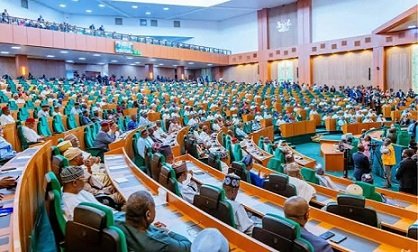
The House of Representatives Committee on Polytechnic and Higher Technical Education has threatened sanctions against four federal polytechnics for evading its investigative hearing into alleged financial irregularities in their financial records and budget implementation.
The committee, chaired by Hon. Fuad Kayode Laguda, issued the warning on Wednesday after the four institutions failed to appear despite receiving invitations to explain discrepancies discovered in documents they had earlier submitted to the committee.
The affected institutions are Federal Polytechnic Ayede, Federal Polytechnic Kaltungo, Federal Polytechnic Damaturu and Federal Polytechnic Kaura Namoda.
The committee said the institutions neither honoured the invitations nor sent any apology or explanation for their absence, despite acknowledging receipt of the letters inviting them to the hearing.
Speaking at the investigative hearing, Laguda expressed displeasure over the development, saying committee members had waited for the institutions while contending with other legislative responsibilities.
“Today’s meeting was called, and four institutions were invited for a meeting that was slated for one o’clock. But as we can all see, we are starting the meeting at 2.45.
“A lot of members have been here earlier, going and coming back because of legislative duties that they have. But unfortunately for us, and to our great displeasure, the four institutions that were invited did not show up. Neither did they send any apology or excuse for not being here today,” he said.
The chairman said the institutions had received and acknowledged the invitation letters.
Laguda explained that the committee summoned the institutions after inquiries into their internally generated revenue and other financial activities, as well as to scrutinise their budget performance between 2023 and 2025.
He said the committee had requested details of their capital, overhead, and personnel expenditures, along with copies of their annual financial statements for the stipulated years.
The committee also sought to establish whether deductions, including insurance-related deductions, were properly accounted for and whether the institutions made the required remittances from their internally generated revenue to the Federation Account.
According to him, a review of some of the documents previously submitted by the institutions revealed several irregularities, prompting the committee to invite them for further clarification.
“However, some of the institutions whose earlier submissions we have gone through had a lot of irregularities, so to speak, in what they submitted. And maybe that is why the four schools refused to honour the calls of the National Assembly without giving any reason whatsoever,” he said.
The chairman accused the institutions of evading parliamentary scrutiny to avoid accounting for their activities, warning that the committee would deploy all legislative powers available to it against them.
“We are sending this message to them through the media and the public to know that they have actually evaded the National Assembly in order not to give account of what has transpired in their institutions.
“It shows that the irregularities that were found in their submission, they do not have any defence for them. However, they should know that all legislative functions and powers available to us will be used against them accordingly because they are trying to block us from carrying out our constitutional rights to carry out oversight on them,” Laguda said.
Contributing to the deliberations, another committee member said the National Assembly’s oversight responsibilities were constitutionally backed and that the institutions had no justification for refusing to honour the invitations.
The lawmaker said the committee had written to the institutions and sent reminders, but they still failed to appear.
He said the committee had identified irregularities in the institutions’ financial activities, particularly in their recurrent expenditure and management of internally generated revenue.
According to him, the institutions receive allocations for overhead costs and other recurrent expenditures through the federal budget while also generating revenue from their operations.
He said the committee wanted the institutions to provide evidence that they were remitting the required share of their internally generated revenue to the Federal Government.
He further questioned the practice of some institutions allegedly deploying almost 90 per cent of their internally generated revenue to recurrent expenditure despite receiving government allocations for the same purpose.
“If you look at their IGR, most of them invest almost 90 per cent of their IGR in adding it to the recurrent expenditure which has been allocated to them by government. So, I think these are questionable things that they need to come here and answer and give us proof and evidence that they have strictly adhered to those principles,” the member added.
Credit: Thenation