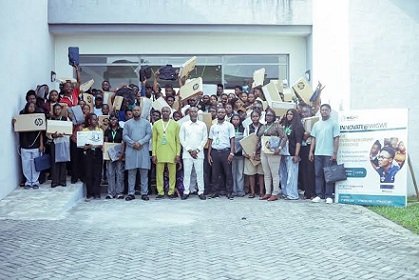
The Federal Government, in partnership with IHS Nigeria and the Borno State Government, has inaugurated the Ambassador Babagana Kingibe Innovation Hub in Maiduguri to expand digital skills development, promote technological innovation and create economic opportunities for young people.
The facility, commissioned on Monday by Vice-President Kashim Shettima, will also serve as a training and collaboration centre for participants in the Federal Government’s Three Million Technical Talent programme in Borno State.
According to a statement issued by the Federal Ministry of Communications, Innovation and Digital Economy on Tuesday, the initiative forms part of efforts to extend digital opportunities beyond major urban centres and increase participation in Nigeria’s digital economy.
The statement read, “Vice President of the Federal Republic of Nigeria, Senator Kashim Shettima, today officially commissioned the Ambassador Babagana Kingibe Innovation Hub in Maiduguri, Borno State, reinforcing the Federal Government’s commitment to expanding digital opportunities, strengthening technical talent development and supporting innovation across the country.”
Speaking at the inauguration, Shettima commended the Minister of Communications, Innovation and Digital Economy, Bosun Tijani, for expanding access to digital skills development across the country.
“His Ministry recognises that digital opportunities must reach Maiduguri and other communities within the state,” the Vice-President said.
Shettima described the 3MTT programme as an important intervention for equipping young Nigerians with the skills required to compete in the global digital economy.
He expressed optimism that the innovation hub would become a “playground of ideas”, providing young people in Borno with opportunities to demonstrate their capabilities and pursue careers in technology.
In his remarks, Tijani said the Federal Government was complementing investments in broadband infrastructure with technical skills development to ensure that Nigerians could benefit from improved connectivity.
“As we connect more communities, we are also helping more young people acquire the skills they need to make use of that connectivity,” the minister said.
Tijani disclosed that applications for the next cohort of the 3MTT programme were expected to open in December, adding that the Maiduguri facility would enable participants to collaborate on projects, develop professional portfolios and showcase their skills to prospective employers.
He urged young people in Borno to take ownership of the facility, noting that its long-term impact would depend on their participation and productive use of its resources.
The minister also highlighted other digital infrastructure interventions, including the National Digital Alphanumeric Postcode System, aimed at strengthening Nigeria’s digital ecosystem.
Borno State Governor, Babagana Zulum, welcomed the investments, describing improved internet connectivity as critical to economic development, employment generation and efforts to address security challenges.
Zulum disclosed that several local government areas in the state still lacked adequate connectivity, expressing his administration’s readiness to collaborate with the Federal Government to bridge the gap.
“I therefore express my political will and commitment to partner with the Ministry of Communications, Innovation & Digital Economy to ensure the sustainability of all the projects coming through the support of the Ministry,” the governor said.
The ministry added that the innovation hub complemented its broader digital development strategy, which includes Project BRIDGE, technical talent development and the establishment of community-based innovation centres.
It reaffirmed its commitment to working with state governments, development partners and private sector organisations to expand digital access and create opportunities for technology-driven businesses.
The PUNCH reports that Project BRIDGE is a $2bn public-private partnership initiative designed to deploy 90,000 kilometres of fibre-optic infrastructure across the 36 states and the Federal Capital Territory, connecting all local government areas, with financing from the World Bank, African Development Bank and European Bank for Reconstruction and Development.