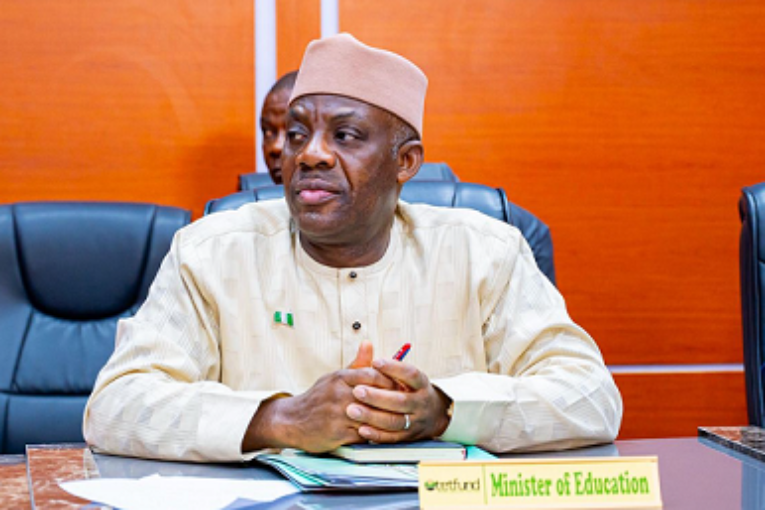
The Minister of Education, Tunji Alausa, on Thursday urged the National Assembly to significantly strengthen funding for the Federal Ministry of Education’s 2026 budget proposal to address critical challenges, including acute teacher shortages, weak infrastructure and security concerns in public schools.
Alausa made the appeal while defending the Ministry’s 2026 estimates before the Senate and House of Representatives Joint Committee on Education at the National Assembly Complex, Abuja.
The minister assured lawmakers that the Ministry would ensure full and transparent implementation if the proposal is approved, stressing that increased investment would translate into measurable improvements across the sector.
“We aim to convince the National Assembly that a minimum of 20 per cent allocation to education, as recommended by UNESCO, should serve as the benchmark for future budgets.
“Education is the backbone of national development. Without adequate funding, our schools cannot equip students with the knowledge and skills required to compete globally and thrive in the 21st century,” Alausa said.
Highlighting the staffing challenge, Alausa disclosed that Federal Unity Colleges are currently facing a deficit of more than 3,500 teachers, a gap that is severely affecting the teaching of core subjects such as science, mathematics and technical education.
“The shortage of qualified teachers is crippling our efforts to deliver quality education and produce graduates who can compete on the global stage,” he said.
He called for urgent funding to recruit, train and retain competent teachers, noting that closing the manpower gap is critical to improving learning outcomes and strengthening Nigeria’s human capital base.
The minister also raised concerns about the safety of students and staff, particularly in schools located in areas affected by kidnapping, banditry and other security threats.
He noted that many institutions remain unfenced and lack stable electricity, making it difficult to deploy modern surveillance and security systems.
“Our children must learn in safe environments. Security is non-negotiable, and adequate funding is essential to install surveillance systems, construct perimeter fencing, and implement other protective measures to safeguard our learners,” he said.
Alausa further pointed to severe deficits in classrooms, hostels, laboratories and library facilities, warning that overcrowding, obsolete equipment and inadequate learning resources are undermining practical teaching and research.
He also underscored the need to expand Information and Communication Technology infrastructure through investment in computers, internet connectivity and digital learning tools to prepare students for a knowledge-driven global economy.
To address delays and funding uncertainties affecting government-sponsored students, the minister proposed the establishment of a dedicated, ring-fenced scholarship account.
He said foreign tuition and allowances should be paid in local currencies or US dollars to shield beneficiaries from exchange rate volatility.
“Many of our scholarship beneficiaries are indigent yet high-performing students. Inadequate funding exposes them to hardship and limits their potential. Immediate and sustained funding is critical to safeguard their future,” he said.
Alausa explained that the 2026 proposal aligns with the policy priorities of President Bola Tinubu, the Education Sector Roadmap and the Renewed Hope Agenda.
According to him, the budget is designed to expand access for out-of-school children, improve school safety, strengthen teacher capacity and reposition tertiary institutions to produce a skilled workforce.
“The 2026 budget is not merely a financial plan; it is a blueprint for transforming Nigeria’s education system. Every naira invested will yield long-term dividends in the form of skilled citizens, economic growth, and national prosperity,” he said.
He appealled to lawmakers, “Without adequate resources, our schools cannot fulfill their mandate. Investing in education is investing in the future of Nigeria. We urge lawmakers to prioritize education as a national imperative and support this budget to ensure the dreams of our children and the aspirations of our nation are realised.”
Nigeria’s public education system has long struggled with inadequate funding, with annual allocations consistently falling far below the 20 per cent benchmark recommended by UNESCO. In recent years, the sector has typically received between 6 and 10 per cent of the national budget.
The funding gap has contributed to persistent infrastructure decay, overcrowded classrooms, weak laboratory and library facilities, and limited access to modern learning technologies, particularly in state-owned primary and secondary schools.
Many states also face difficulties meeting salary obligations and recruiting qualified teachers, worsening the learning crisis and contributing to declining education quality.
Analysts say sustained underinvestment has been a major factor behind Nigeria’s large population of out-of-school children and the growing disparity between public and private education standards.
Stakeholders have repeatedly warned that without a sustained increase in funding and improved utilisation, efforts to reform the sector and improve learning outcomes may continue to yield limited results.