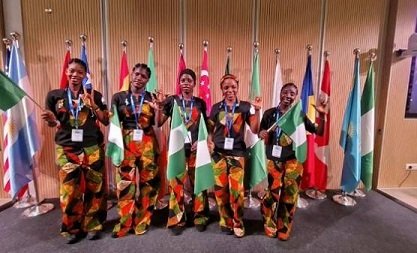
Five deaf Nigerian secondary school pupils have reached global finals in an international technology competition with an artificial intelligence-powered application designed to improve access to menstrual products and health information, particularly for girls with disabilities.
NigerianCulture Magazine
The team, known as the STRIM Girls, represented Government Secondary School, Kuje, Abuja at this year’s Technovation Girls World Summit in Bengaluru, India. They presented their innovation, Saving Pad (SP), among entries from teams across more than 160 countries.
The Technology Beyond Disability Initiative (TechBDI), which trained and mentored the team, announced this in a statement. It described the innovation as an effort to bridge the gap between digital technology and practical support for girls experiencing period poverty.
The five pupils are: Adegbile Teniola Vivian, Sulaiman Maryam Adenike Isah, Moses Joy, Ukpapi Theresa Uzepi, and Yusuf Ruth.
According to TechBDI, Saving Pad combines a digital platform with physical sanitary pad banks to help girls locate menstrual products, request supplies, and access menstrual health education, while enabling schools and partner organisations to monitor stock and coordinate restocking.
The initiative addresses the challenge of girls experiencing menstruation unexpectedly at school without sanitary products, with possible consequences for their dignity, health, and attendance.
TechBDI said the difficulties could be greater for deaf girls because of communication barriers, limited access to accessible menstrual health education, and the stigma surrounding menstruation.
The organisation said the students developed Saving Pad to connect digital information with practical support, allowing users to identify nearby pad banks through an interactive map or request products through the application.
The platform also features period tracking and forecasting, as well as menstrual health education designed to make information more accessible to Deaf learners.
For girls without smartphones or access to digital services, female attendants at participating schools and health facilities can provide assistance, ensuring that access to sanitary products does not depend solely on owning a device.
Another feature is an inventory management system that tracks supplies at participating pad banks and alerts coordinators when stocks run low.
TechBDI said the system was designed to help schools and partner organisations anticipate shortages and replenish supplies before girls are left without products.
Beyond individual users, the application offers a management tool for non-governmental organisations, donors and humanitarian agencies supporting menstrual health programmes.
Through a central dashboard, participating organisations can monitor stock levels across different locations, assess distribution patterns and use demand data to guide replenishment and resource allocation.
The system is also intended to reduce reliance on manual reporting and requests while improving accountability in the distribution of donated menstrual products.
TechBDI said Saving Pad had progressed beyond the prototype stage, with a pilot programme launched in three special schools in Abuja in partnership with the Deaf Women Aloud Initiative (DWAI).
The pilot established physical pad banks linked to the digital platform.
The team’s proposed expansion plan includes extending the service to primary healthcare centres and vulnerable communities, with the longer-term ambition of building an integrated national pad bank network.
At the international summit, the students presented the project as an example of how inclusive technology and community partnerships could address public health and education challenges.
The innovation aligns with the United Nations Sustainable Development Goals (SDGs) on good health and well-being, quality education, and partnerships for development.
According to TechBDI, the girls received a rousing welcome at the airport upon their return to Nigeria, led by the Director-General and Chief Executive Officer of the Maryam Babangida National Centre for Women Development, Dr. Adedayo Benjamins-Laniyi, alongside members of her executive team.
The organisation described Benjamins-Laniyi as one of the supporters who encouraged the team during its journey to the global competition.
TechBDI said the achievement demonstrated the potential of young people with disabilities to contribute to technology development when given access to relevant training, mentorship and international platforms.