By Phillip Asuquo
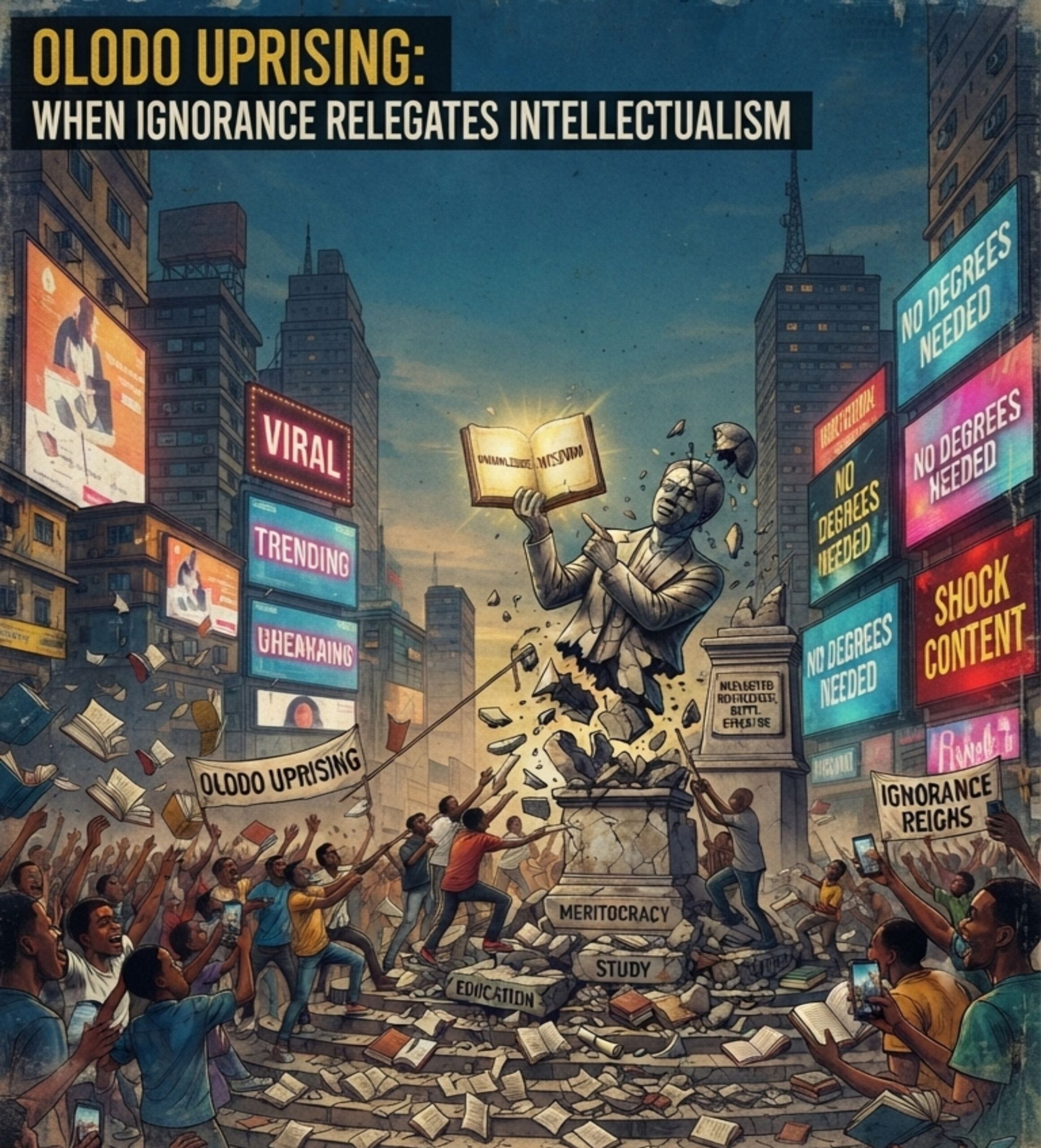
A few weeks ago, “Olodo Uprising” became a national catchphrase after rapper YCee gave a name to something many Nigerians had been observing quietly for years.
The phrase didn’t create the problem. It simply described it.
Long before it became a trend, many intellectuals had raised concerns about the steady relegation of intelligence in our public conversations, our social media spaces, and even in governance.
I remember a conversation with my friend, Mr. Chris, a man I respect. He said something that has stayed with me: “It seems there is an intentional push to silence intellectuals while creating more room for the opposite to dominate politics and public discourse.”
The statement struck me because I had sensed the same thing. I just didn’t have the words for it.
Over the years, we’ve watched public discourse gradually shift. Substance is often replaced by spectacle. Insight competes with noise. Knowledge struggles for attention while gimmicks effortlessly trend. Being loud increasingly seems more rewarding than being informed.
The greatest casualty of this shift isn’t today’s headlines.
It’s the next generation.
I grew up in a time when thinkers were celebrated. Writers, scholars, innovators, teachers, and visionary leaders shaped our aspirations. Young people wanted to read more, think deeper, speak better, and become people of substance because society rewarded intellectual growth.
Our minds were seen as our greatest assets.
Today, the incentives appear different. Virality often outranks value. Popularity sometimes overshadows competence. Depth is dismissed as “too serious,” while mediocrity can become entertainment.
This is not nostalgia for the past, nor is it a condemnation of an entire generation. Every generation has its strengths and weaknesses.
But every generation must also decide what it chooses to celebrate.
If we consistently applaud ignorance while mocking excellence, we shouldn’t be surprised when fewer people aspire to become thinkers. When intelligence is no longer admired, society gradually loses the very people capable of solving its biggest problems.
A nation cannot joke its way into prosperity.
Innovation is born from ideas. Good governance is built on competence not just staged political or party loyalty. Economic transformation is driven by knowledge. Sustainable progress has always depended on people who think before they speak, study before they conclude, and build before they boast.
Ironically, we are living in the most empowering era in human history. Never before have young people had access to so much knowledge, so many learning platforms, and transformative technologies like Artificial Intelligence. AI is not here to replace thinking; it is here to amplify it. It can help us learn faster, create better, solve harder problems, and build ideas that previous generations could only imagine.
The tragedy would be to use the greatest tools ever created merely to produce more noise, chase empty trends, or dumb ourselves down.
The opportunity before this generation is far greater than the one mine had. The question is whether we will use these powerful tools to elevate our minds or simply entertain our distractions.
Perhaps the real uprising we need isn’t an Olodo Uprising.
Perhaps it’s an Intellectual Uprising—where reading becomes fashionable again, critical thinking becomes attractive again, meaningful conversations return to our timelines, and young people leverage technology, especially AI, to build solutions, create value, and shape a better future.
Because every society eventually becomes a reflection of what it celebrates.
The question is no longer, “What are we celebrating today?”
It is, “What kind of generation will history remember us for?”
Shout out to my brothers, John Obidi and Emmanuel. They are among many from my generation who built influence from intellectual capital. People followed us because of our ideas, our insights and the value we created—not because of what we drove, wore or flaunted. Our minds were our greatest assets.
Today, too often, we celebrate outcomes without questioning the values behind them. Audiences reward it. Brands endorse it. Algorithms amplify it. We are all shaping the culture we complain about
Again, what kind of generation will history remember us for?
AsuquOtes
Poimen | Strategist