By Dr. Bunmi Awoyemi
For decades, Nigeria’s education sector resembled a wounded colossus—vast in potential, yet shackled by chronic disruption, under-investment, and policy hesitation. Lecture halls fell silent during endless strikes. Laboratories aged into obsolescence.
Technical colleges languished in obscurity. Students struggled beneath the crushing weight of tuition costs, transportation hardships, and dilapidated infrastructure.
But history occasionally produces moments when a nation’s trajectory bends sharply toward renewal.
Nigeria may well be living through such a moment under the stewardship of Bola Ahmed Tinubu.
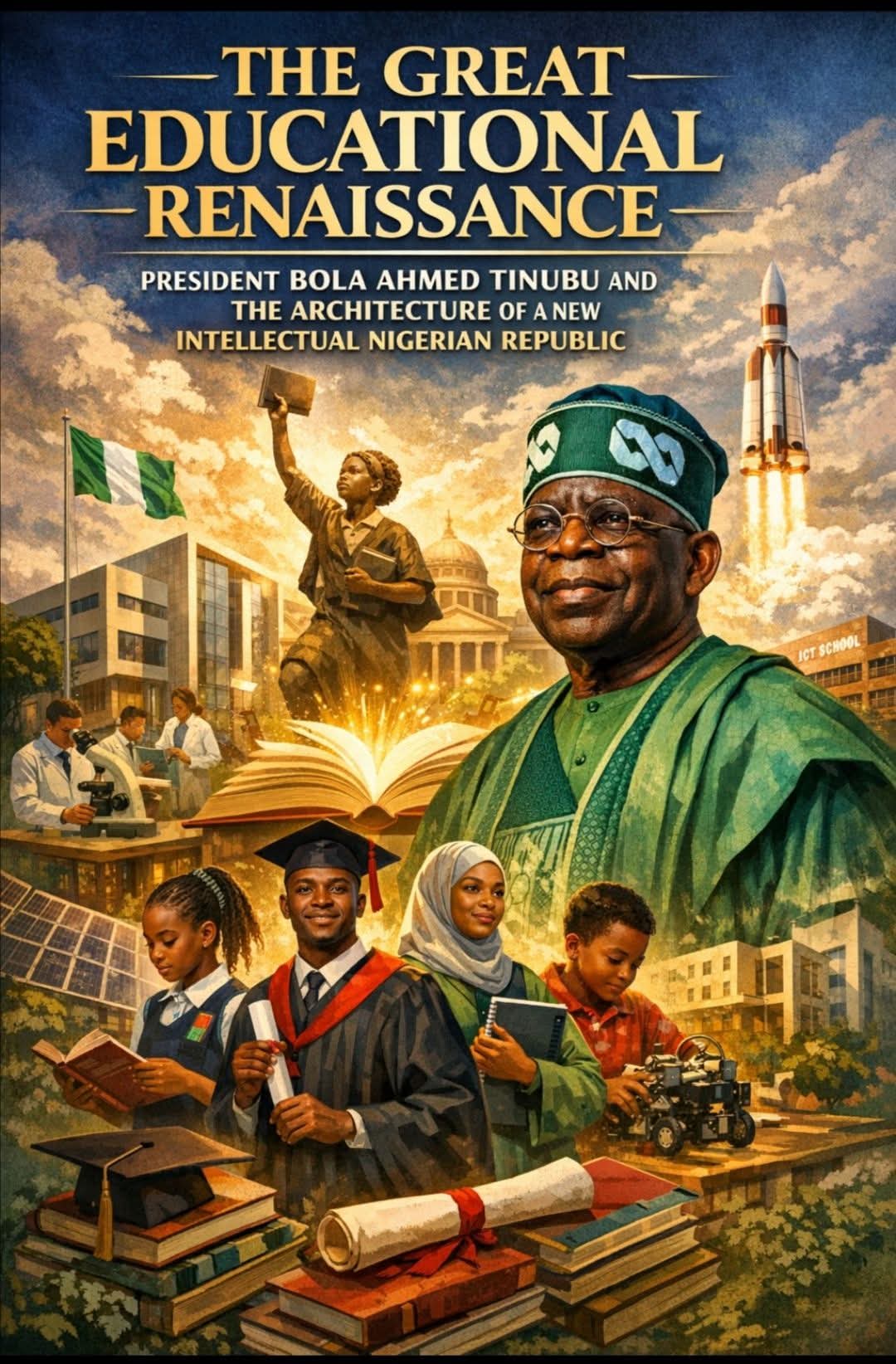
Across universities, technical colleges, unity schools, and research institutions, the contours of an educational renaissance are beginning to take shape—one defined by stability, access, infrastructure renewal, and the deliberate cultivation of human capital as the ultimate currency of national greatness.
The Silencing of the Strike Era
Between 1999 and 2023, Nigeria’s public universities endured a staggering four years and eight months of shutdowns due to industrial disputes with the Academic Staff Union of Universities.
From the administrations of Olusegun Obasanjo through Umaru Musa Yar’Adua and Goodluck Jonathan to Muhammadu Buhari, Nigerian students repeatedly watched their academic dreams suspended in the purgatory of prolonged strikes.
Entire academic calendars collapsed.
Graduation timelines disintegrated.
A generation lost precious years of productive life.
Yet in less than two years since the inauguration of President Bola Ahmed Tinubu, the once-perennial ASUU strike phenomenon has shrunk to a mere nine days.
Nine days.
A problem that consumed 56 months in 24 years has been compressed into a statistical whisper.
The Historic January Accord
On January 14, 2026, the Federal Government formally unveiled the renegotiated 2009 agreement with the Academic Staff Union of Universities—a landmark accord designed to remove the structural triggers of recurring industrial disputes.
Nigeria’s Minister of State for Education, Maruf Tunji Alausa, described the agreement as a foundational pillar of the Renewed Hope Agenda, capturing for the first time the essential ingredients required to sustain a globally competitive university system within a single aligned framework.
At the heart of the agreement lies a 40 percent upward review of academic staff emoluments, implemented through the Consolidated Academic Tools Allowance (CATA)—a mechanism designed to empower lecturers with the intellectual resources required for world-class research and scholarship.
Complementing this reform is the Professorial Credit Allowance, which provides:
• ₦1.8 million annually for professors
• ₦840,000–₦870,000 annually for readers.
Nine previously ambiguous allowances have also been restructured, codified, and tied strictly to duties performed—replacing decades of confusion with clarity and accountability.
The era of strike-driven negotiation is gradually giving way to predictable academic stability.
The ₦161 Billion Student Liberation
Yet the transformation does not end with lecturers.
It extends directly to the students themselves.
Through the groundbreaking Nigeria Student Loan Scheme, administered by the Nigerian Education Loan Fund, the Tinubu administration has launched the most ambitious student financing program in Nigeria’s history.
As of early January, the scheme has already disbursed ₦161.97 billion.
The figures are monumental:
• ₦89.94 billion paid directly to institutions for tuition and fees
• ₦72.03 billion paid directly to students as upkeep allowances
Meanwhile, more than 1.33 million students have applied.
This initiative—providing interest-free loans to students in public tertiary institutions—is quietly dismantling the economic barriers that have historically denied millions access to higher education.
Education, once constrained by financial privilege, is steadily becoming a democratic gateway to opportunity.
The ₦45,000 Technical College Revolution
But the Tinubu educational revolution extends beyond universities into the vital realm of technical and vocational education.
In a move that could fundamentally reshape Nigeria’s labour economy, the administration has introduced a ₦45,000 monthly stipend for every student enrolled in technical colleges nationwide.
The initiative, announced by the Executive Secretary of the National Board for Technical Education, Idris Bugaje, ensures that students pursuing vocational skills will receive not only financial support but also:
• Fully covered tuition fees
• Funding for industrial attachments
• Payments to industry-based “master class” instructors
• Financing of professional skill certification.
To power this transformation, the Federal Government has approved ₦120 billion for advancing technical and vocational education nationwide.
This policy effectively provides young Nigerians with a golden parachute into entrepreneurship—equipping them with the skills to create jobs rather than merely seek them.
Rebuilding the Foundations: Unity School Infrastructure
Educational renewal also requires physical transformation.
To this end, the Federal Government has approved ₦80 billion for the modernization of Nigeria’s Unity Schools.
The allocation includes:
• ₦40 billion for rehabilitation of facilities
• ₦20 billion for security infrastructure such as fencing and access control
• ₦20 billion for solar energy installations
These upgrades promise safer unity school campuses, reliable electricity, and a more conducive learning environment for thousands of students and teachers.
Empowering Scholars and Expanding Opportunities
Additional interventions are expanding academic opportunities across the country.
The Presidential Amnesty Programme has distributed 663 laptops to final-year scholarship beneficiaries across 26 partner and 72 non-partner universities, enhancing research capacity and digital literacy.
Meanwhile, the Federal Government’s scholarship programs have continued to support thousands of students through initiatives such as:
• The Nigerian Scholarship Award
• The Commonwealth Scholarship
• The Bilateral Education Agreement Scholarship
• The Teachers Internship Scheme.
Between May 2023 and April 2024, nearly 2,889 education students received ₦75,000 bursary awards through the Federal Scholarship Board.
Housing the Scholars of Tomorrow
Recognizing the acute shortage of student accommodation nationwide, the Federal Executive Council approved a €30 million concessional loan from the French Development Agency to support large-scale student housing projects.
Working in partnership with Family Homes Fund Limited, the initiative aims to deliver sustainable, clean-energy housing solutions for tertiary institutions across the country.
Nigeria’s Minister of Finance, Wale Edun, described the intervention as critical to the stability of the education sector, given the severe accommodation deficit affecting Nigerian universities.
Transportation Relief and the Energy Transition
Students have also begun to benefit from the government’s CNG-powered university bus initiative, which launched at the University of Abuja.
The program—part of the Project CNG Special Palliative Relief for Universities Transportation—aims to deploy clean-energy buses across 20 federal universities, reducing transportation costs while aligning with Nigeria’s broader energy transition strategy.
Rebuilding Nigeria’s Medical Education Pipeline
Perhaps one of the most consequential interventions lies in the health sector.
Through the Tertiary Education Trust Fund, the Federal Government has approved a ₦110 billion investment in 18 university medical schools across Nigeria.
Each institution will receive approximately ₦4 billion to strengthen programs in:
• Medicine
• Dentistry
• Pharmacy
• Nursing
The initiative targets universities including the University of Ibadan, University of Lagos, Ahmadu Bello University, and University of Nigeria.
The objective is clear: expand training capacity, counter the devastating effects of medical brain drain, and dramatically increase the number of doctors graduating annually from Nigeria’s universities.
From Educational Crisis to Educational Civilization
Taken together, these initiatives form a sweeping architecture of reform:
• Ending the ASUU strike cycle
• Financing student education
• Reviving technical and vocational training
• Rebuilding school infrastructure
• Expanding scholarships and research tools
• Improving student housing and transport
• Strengthening medical education.
This is not incremental policy tinkering.
It is a systemic reconstruction of Nigeria’s human capital engine.
The Quiet Judgment of History
Nations rise not merely on the strength of their natural resources but on the brilliance of their minds.
If the reforms now unfolding are sustained, historians may one day record that under President Bola Ahmed Tinubu, Nigeria began the long journey from educational fragility to intellectual sovereignty.
The strike sirens are fading.
The gates of access are widening.
And across the nation’s classrooms, laboratories, and workshops, the architecture of a new Nigerian educational civilization is steadily rising.
Dr. Bunmi Awoyemi is a Real Estate Developer and Builder.