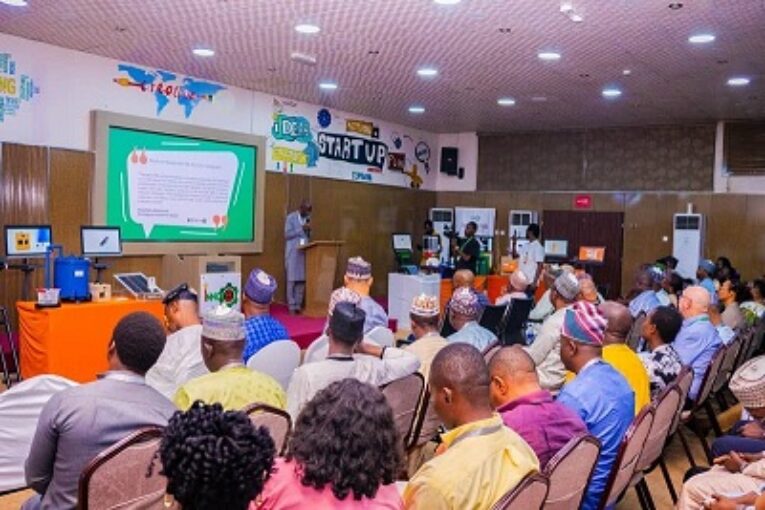
Efforts to transform research into innovation got a boost in Nigeria as TETFund Alliance for Innovative Research (TETFAIR) and Innov8 Hub, a non-profit and non-governmental innovation centre, got together to unveil 15 brand-new, fully functional prototypes developed by academics and researchers from tertiary institutions across Nigeria.
The event was a one-day demo for the Academic Solutions Incubation Programme (ASIP) in Abuja.
The demo titled: “TETFAIR 5,6,7 and ASIP: Demo Day” was organised by Innov8 Hub in collaboration with the Tertiary Education Trust Fund (TETFund) Alliance for Innovative Research (TETFAIR).
Their works span across agriculture and health to construction technology, digital solutions, energy, among others.
It was a Showcase event for the Academic Solutions Incubation Programme (ASIP)
Through both programmes, participating researchers have undergone an intensive journey that includes: Business development; Business modelling; Product refinement; Technical mentorship; Prototype design and fabrication.
Speaking on the sidelines of the event, the NGO’s Deputy General Manager, Dr Deji Ige, explained that the essence of the event is to see how to translate from research to innovation.
Ige said, “We are showcasing outcomes of partnership with TETFund.
Innov8 Hub is the implementing partner of TETFAIR and ASIP.
“The choice of lecturers as participants was made through an open call.
“Such as calls for application from academics in Nigerian tertiary institutions that have researchers trying to translate and transform ideas into solutions and solve challenges in the Nigerian society.
“A lot of people applied, and the most viable and achievable ideas were selected through a free and fair process, after which successful academics and researchers were admitted into the programme.
“There should be an end goal to every research, and that goal should be transformation. Researchers should be solution-driven.
“This is what formed the partnership between TETFAIR and Innov8 Hub. So, what are the end goals of these solutions?
“These are solutions that have reached the Minimum Viable Product (MVP) stage and can proceed to commercialisation if there is investment.”
“So, every participant within TETFAIR, ASIP, and other TETFund initiatives implemented by Innov8 Hub participates free of charge. No participant has to pay for their journey.
“Once you are selected, you are catered for from the beginning to the end — all expenses paid,” he said.
In his remarks, Mr Sunny Echono, Executive Secretary of TETFund, said that the demo sought to promote the relevance of teaching and learning about innovation across institutions to the immediate environment.
He said, “Our national economy is dwindling because Nigeria and the world today have moved from producing graduates who go and fill positions either in administration or work in offices.
“Given the rapid expansion in our population and the evolution of the knowledge economy that places so much emphasis on skills and talents, we felt there was a fundamental need for a shift in our education system.
“With the increasing demand for creativity and innovation, it has become essential to rethink how we prepare individuals for future opportunities and challenges.
“To do that, we had to start with the academia, the teaching staff, the faculty, because when you teach a teacher, and he goes back, you will also be able to translate that to the students.
“This is why we launched so many programmes in partnership with Innov8 Hub.
“And these programmes are designed to equip our lecturers, to reignite the creative and the research spirit in them,” Echono said.
He revealed that no fewer than 72 different innovation hubs, similar to Innov8 Hub, were put in place across various campuses and are expanding on an annual basis.
The Polytechnic of Ibadan demonstrated Funfit, a fitness device that gamifies exercise while generating electricity. Ramat Polytechnic, Maiduguri, presented Rampokids, a nutritious cereal for children aged 2–5, produced from local crops. Federal Polytechnic, Ede, introduced Powermantech, while Federal Polytechnic, Ado-Ekiti, unveiled Ecopave.
Other prototypes included Orufe, a cassava shredder developed by the Federal College of Education (Technical), Umunze; and Agromareh, an AI-driven crop health monitoring tool from the Federal College of Education, Pankshin.
The Federal College of Education, Katsina, showcased Agromech, a motorised hand-guided two-row planter, while Usman Danfodiyo University, Sokoto, presented Solarmilkpro, a solar-powered milking machine.
The University of Agriculture and Environmental Sciences, Umuagwo, Imo State, introduced Agronova Dryer, a hybrid solar drying system. Modibo Adama University unveiled Flo-Vend, an automated menstrual product vending machine, and the Federal University of Agriculture, Abeokuta, presented Tripleshield Agro, an eco-friendly pesticide technology.
The programme featured training of the lecturers on business development, business modelling, product refinement, technical mentorship, prototype design, and fabrication.
It also showcased “Deal Rooms” where innovators engaged directly with investors, industry leaders, and potential commercial partners to explore, uptake partnerships, and investment opportunities.
Highpoints of the event were a live pitch session, presentation of the leaderboard award/my tertiary story, the ordeal of an innovator-stage play, Ecolab showcase, and presentation of patents and copyrights.
The Showcase also featured Deal Rooms, where innovators will engage directly with investors, industry leaders, and potential commercial partners to explore uptake, partnerships, and investment opportunities.