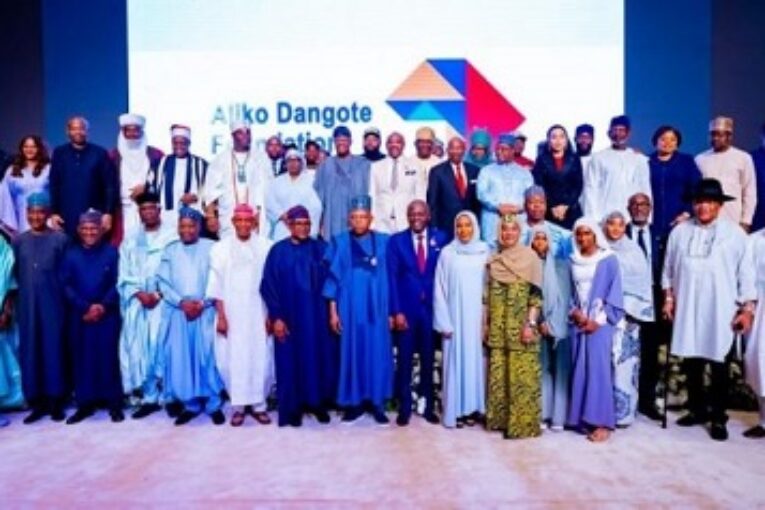
Industrialist, Aliko Dangote, yesterday announced a N100 billion annual education support initiative to reduce financial barriers that push many young people out of school. The programme will cost over N1 trillion in 10 years.
The Presidency praised the initiative as the largest private education support programme in Nigeria and a boost to the Federal Government’s human capital development agenda.
At the launch in Lagos, Dangote said the plan will support 45,000 new students yearly from 2026, rising to 155,000 by the fourth year and staying at that level till the tenth year. The scheme will reach 1.3 million students across all 774 local government areas.
The initiative, comprising four programmes, would focus on areas with high education gaps. The Aliko Dangote STEM Scholars scheme will fund 30,000 undergraduates in public universities and polytechnics, with tuition based on actual fees.
Another 5,000 students in technical and vocational institutions will receive tools and training support under the Aliko Dangote Technical Scholars scheme to complement the Federal Government’s free tuition policy for technical and vocational education and training (TVET) students.
The MHF Dangote Secondary School Girls Scholars programme, named after his daughters – Mariya, Halima and Fatima- will support 20,000 girls yearly from JSS1 to SSS3, with continued support into tertiary education. States with the highest number of out-of-school girls will be prioritised.
The Dangote Teacher Training Programme will start with 10,000 secondary school STEM teachers in 39 government colleges attended by MHF scholars and later expanded nationwide.
Dangote said financial hardship, not lack of talent, was responsible for increased number of out of school students. He described the initiative as a strategic investment in Nigeria’s future.
The businessman said the Foundation has invested heavily in health, nutrition, empowerment and humanitarian support for more than three decades, adding that education was the strongest driver of social mobility.
He noted that government, the private sector and communities must work together to transform education, ensuring more children were empowered.
The Foundation will use a digital, merit-based system for verification, disbursement and monitoring, working with NELFUND, JAMB, NIMC, NUC, NBTE, WAEC and NECO. It will track retention, completion and post-school outcomes.
A Programme Steering Committee chaired by Justice Sidi Dauda Bage, Emir of Lafia, has been set up with members including former vice chancellors, education administrators, technical experts and representatives of the Dangote family.
Dangote also said he has committed 25 per cent of his personal wealth to the Foundation, adding that progress on the initiative would be reviewed in 2030 under the Dangote Group’s Vision 2030 strategy.
He commended President Bola Ahmed Tinubu’s education reforms and efforts by the Education Ministry, SUBEBs and state governments to support learners.
The initiative builds on the Foundation’s projects, including university hostels, the Mu Shuka Iri early-learning programme in Kano, the Aliko Dangote School for Orphan Girls in Maiduguri funded with N500 million yearly and a N15 billion commitment to upgrade the Aliko Dangote University of Science and Technology, Wudil.
Vice President Kashim Shettima said the intervention shows the vital role of the private sector in national development, warning that an uneducated population would become a liability. He said the initiative aligned with ongoing reforms such as NELFUND, UBEC interventions, TETFUND expansion and accelerated TVET programmes.
Education Minister Tunji Alausa said the programme fit into the government’s plan to build a knowledge-driven economy, saying every local government area would benefit.
Lagos State Governor Babajide Sanwo-Olu, speaking for the governors, pledged their support.
Justice Bage described the scheme as unprecedented, while the Ooni of Ife, Oba Adeyeye Ogunwusi, praised Dangote’s unmatched impact in private-sector development. He said the initiative was both strategic and transformational.