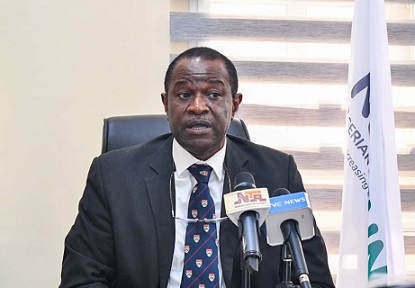
n this interview, GRACE EDEMA speaks with the Managing Director of the Nigerian Education Loan Fund, Mr Akintunde Sawyerr, about delays, data issues, transparency concerns, and the future of the student loan scheme
During the early stages of the NELFUND, and even up to part of last year, there were issues around network challenges, data processing, and backlogs. Have you been able to address these issues?
We haven’t overcome all the challenges, let me be very clear about that. Our system is largely IT-based, and we depend heavily on data provided by different schools about their students. In fact, students cannot successfully apply for the loan if their institutions’ data is incomplete or inaccurate. Issues such as incorrect details or wrong numbers pose a major problem because the system is automated; if the data is not accurate, it simply won’t process.
Another challenge is that schools operate with varying levels of efficiency when it comes to their IT systems. Each institution has its own processes, which differ significantly from one another. This makes integration complex, as we have to constantly adjust to accommodate both the efficiencies and inefficiencies across institutions.
We have also encountered situations where schools are unable to immediately confirm receipt of funds, sometimes because they cannot access or properly monitor their accounts. This creates uncertainty and delays in communication.
In addition, institutions operate on different academic calendars, with varying timelines for registration, exams, and other activities. However, our disbursement process is tied to when applications are received and processed, not to individual school deadlines. Given the volume of applications coming in from across the country and from different institutions, it is difficult to align payments with each school’s specific schedule.
Overall, these challenges stem from system dependencies, data accuracy issues, and the need to coordinate across multiple institutions with differing structures and timelines.
There was a report in January that over 11,000 students were affected by unpaid upkeep allowances. Are these issues also linked to the challenges you’ve mentioned?
Part of the issue with unpaid allowances stems from incorrect bank account details provided by applicants, which causes payments to bounce back. In some cases, applicants are unable to receive funds because there is no proper name match.
Another issue is that some students did not apply for the upkeep allowance at all, even though it is a separate application from the main student loan.
We have also encountered cases where individuals use someone else’s BVN, often a family member’s. This creates complications, as a BVN cannot be used by more than one person in the system.
Additionally, there is a misunderstanding among some applicants about how the upkeep allowance works. It is not accounted for a full 12-month period from the time of approval; rather, it is meant to cover the remaining duration of the academic session.
So, a combination of incorrect details, application gaps, and misunderstandings about the process has contributed to the delays and unpaid allowances.
There have been arguments that the N20,000 upkeep allowance has become inadequate owing to current economic realities. Are there any plans to increase the allowance?
Well, I would say that students should be appreciative that their school fees are being fully covered, along with the additional N20,000 monthly upkeep. At the moment, there are no plans to increase the allowance in the immediate future.
Of course, it may not always seem sufficient, especially given the current high rate of inflation, but it is not feasible to review or increase the upkeep amount every few months.
Are there measures in place to ensure that funds given to institutions are properly managed and not misused?
We ensure transparency on our part by running all our processes electronically. However, we cannot fully comment on the internal processes of the schools, as that is beyond our control. Our directive to institutions is clear: once school fees are paid, students should be granted access to their academic activities. How schools manage or disburse funds internally is not within our jurisdiction. Our responsibility is to deliver the funds to the institutions on behalf of the students.
How does NELFUND ensure transparency and accountability in its own disbursement process?
All our processes are electronic, creating a clear audit trail. We do not handle cash; funds come into NELFUND electronically and are disbursed electronically.
We also publish details of the funds we receive and disburse. Applications are processed online, and payments go directly from the Central Bank to the accounts of the institutions, making the entire process traceable.
To further strengthen accountability, we require schools to provide acknowledgement receipts for the funds they receive. These confirmations are also made public, ensuring that Nigerians can verify that the money is reaching the intended institutions.
This is a loan. How is the repayment to be done?
It is a loan, so it has to be repaid. However, repayment is not made directly out of pocket in the traditional sense. According to the structure, repayment is handled through the beneficiary’s employer.
Two years after completing NYSC, essentially in the third year after service, the employer begins to deduct 10 per cent of the individual’s salary and remits it to the scheme. So, it’s 10 per cent of their earnings, whether they are paid monthly or weekly, until the loan is fully repaid.
Considering the challenges with institutions, what more needs to be done to make your work smoother?
First, schools need to upgrade their IT systems. That is very important. Secondly, institutions need to work towards aligning their academic calendars. Over the years, disruptions like strikes have left some schools running overlapping sessions, which makes it difficult to determine exactly which academic year students are applying for. Without resolving this, the process will continue to face challenges.
So, schools need to focus on two key areas: aligning their academic calendars and improving their IT systems and responsiveness.
As for us at NELFUND, we need to continue sensitisation, raising awareness among Nigerians that the scheme exists, that it works, and that it is designed to provide real opportunities for students.
Students, on their part, should stay focused on their education. With financial support now available, they should take advantage of the opportunity, ease the burden on their parents, and work hard to succeed academically.
Students should work as hard as they can. With this scheme, money is no longer the primary barrier to their education. They should choose courses that make them employable, stay focused, and aim for the best possible grades so they can be useful to themselves and to the nation.
The reality is that I don’t have full visibility into how schools allocate their budgets or prioritise their spending. For instance, some institutions are dealing with serious security challenges and may need to channel a significant portion of their resources into ensuring the safety of students and infrastructure. Others may not face such issues and can afford to invest more in ICT.
So, it would be unfair to broadly criticise schools for not being fully ICT-compliant, as their circumstances differ. What we do know is that the level of ICT development is not uniform across institutions, and that disparity creates challenges for us.
Ideally, we would like to see a baseline level of ICT infrastructure across all schools to ensure smoother operations. However, these systems require funding and deliberate investment; they don’t come at no cost.
Ultimately, while improved ICT capacity across institutions would significantly enhance efficiency, it is difficult to fault schools without a clear understanding of their individual financial realities and priorities.
What’s your zone-to-zone assessment of how students subscribe to the loan?
From my general observation, uptake varies across regions. In the North, where there has been prolonged insurgency, higher poverty levels, and fewer economic opportunities, there is a stronger willingness to embrace such initiatives. Many people, including students and institutions, are eager to take advantage of opportunities provided by the Federal Government.
In the South-West, there is a strong cultural emphasis on education. People value formal learning and academic qualifications, so there has also been significant uptake of the scheme in that region.
In the South-South, particularly in oil-producing areas, there are relatively more economic opportunities due to the presence of oil companies and related industries. Many state governments and international oil companies also provide scholarships, so the demand for student loans may not be as high.
In the South-East, there is a longstanding cultural hesitation towards taking loans. Many people are generally discouraged from borrowing, and this mindset has influenced the level of participation in the scheme.
Loans are often the last option for many people in the South-East. For them, it is largely a matter of pride. Even though these loans are interest-free and repayment does not begin until years later, and even then through the employer, the prevailing mindset is: why take a loan when you can work hard and earn your own money? Those are the regional differences I have observed.
You mentioned that NELFUND is creating awareness, but many Nigerians may still not fully understand how it works, especially the repayment structure.
This is an interest-free loan, and the application process is entirely online. Applicants are required to provide basic details such as their full name, BVN, and date of birth. At the same time, institutions are expected to upload student data into the system so that applications can be verified and processed.
Once both NELFUND and the institution approve the application, the loan is granted. Some delays may occur during this stage if either party takes time to complete the approval process.
When the loan is disbursed, the funds are sent directly to the school, not to the student. The institution is expected to hold the funds and use them to cover the student’s tuition, thereby granting them access to academic activities for that session. The loan is processed on a session-by-session basis, meaning students are required to reapply each academic session.
In addition to tuition, there is a monthly upkeep allowance of N20,000, which is paid directly to the student, but only if they apply for it and have already been approved for the main loan.
Regarding repayment, the loan is interest-free. Beneficiaries are not required to start repayment until two years after completing their NYSC. Even then, repayment is not made directly by the individual. Instead, employers are required to remit 10per cent of the beneficiary’s salary to NELFUND.
This 10 per cent deduction is based on the individual’s earnings, not the total loan amount, and continues until the loan is fully repaid.
Private institutions often complain about being sidelined. Is the scheme considering this?
I can’t really comment on private institutions. There is a law guiding the scheme, and we are simply following that law. Whether one thinks private institutions should be included or not is something I can determine. We are bound by the provisions of the law.
It’s just like driving in Nigeria; we drive on the right-hand side of the road because that is what the law stipulates. If some people think otherwise, there’s nothing I can do about it; it remains the law.
Credit: Punchng