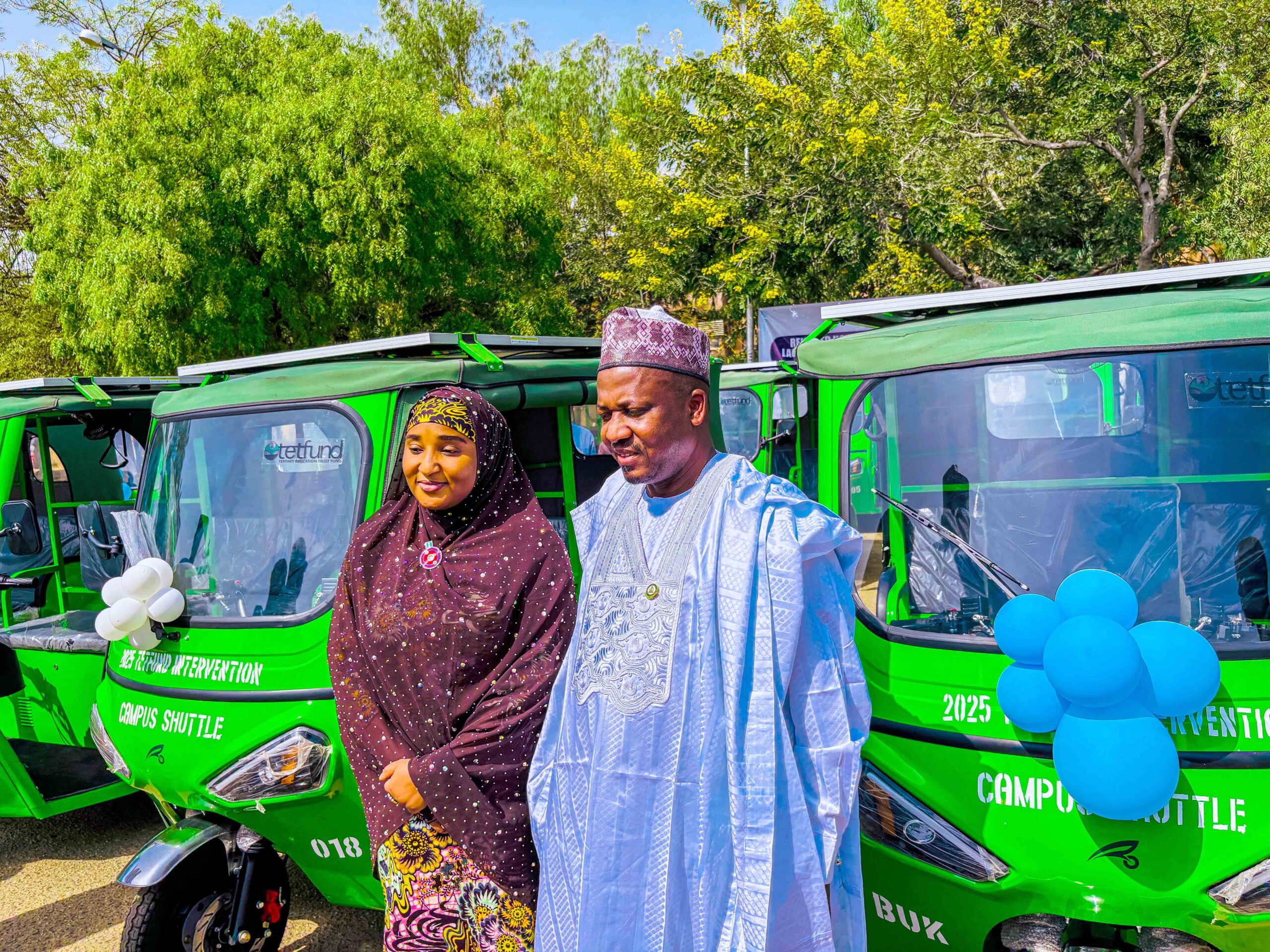
Bayero University, Kano, has commissioned 20 solar-powered tricycles under the Tertiary Education Trust Fund (TETFund) intervention, aimed at enhancing campus transportation, promoting innovation, and advancing green energy solutions in Nigerian universities.
The commissioning ceremony, held on Monday, October 20, 2025, marked a major step in the University’s drive toward sustainable mobility and environmental responsibility.
Speaking during the ceremony, the Vice Chancellor, Professor, Haruna Musa, commended TETFund for the intervention, describing it as a significant contribution to improving welfare and innovation in tertiary institutions in line with the Federal Government’s Renewed Hope Agenda.
“We are delighted to commission 20 solar-powered tricycles provided through TETFund’s special intervention. These vehicles will help ease movement within our campuses and reduce the stress faced by students and staff. Beyond transportation, this project reflects our shared commitment to sustainability and innovation,” Professor Haruna stated.
He explained that the solar-powered tricycles will complement the University’s existing petrol-powered flee. According to him, in addition, the introduction of the solar fleet will help cut fuel costs, reduce carbon emissions, and enhance the University’s green transport policy.
The Vice Chancellor urged members of the University community to make responsible and efficient use of the tricycles, noting that the initiative demonstrates how public institutions can embrace renewable energy solutions for social and environmental impact.
Also present at the ceremony were the Deputy Vice Chancellor Management Services, Professor Aliyu Mu’azu; the DVC Research and Development, Professor Amina Mustapha; the Registrar, Malam Haruna Aliyu; the Bursar, Malam Rabi’u Dauda, and the University Librarian, Dr. Kabiru Dahiru Abbas.
The commissioning represents yet another milestone in TETFund’s ongoing commitment to transforming Nigeria’s tertiary education sector through targeted investments in research, infrastructure, and sustainable innovation. It also reinforces the University’s mission to remain a model of academic excellence and environmental consciousness.