The Federal Government said it is implementing various interventionist policies aimed at strengthening the education sector in the country.
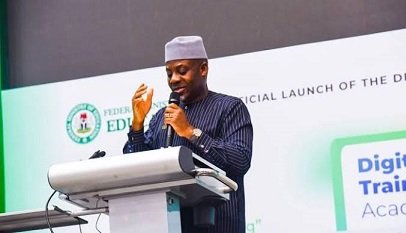
The Minister for Education, Dr Maruf Alausa, stated this at the opening of the 85th Joint Consultative Committee on Education Plenary Meeting with the theme, “Infrastructural Development and Teacher Motivation: Panacea For Improved Learning Outcomes,” held in Port Harcourt, Rivers State on Tuesday.
Alausa, who was represented by the director overseeing the office of the Permanent Secretary, Federal Ministry of Education, Dr Folake Olatunji-Davies, said the President Bola Tinubu-led government is not just interested in physical infrastructure but in the quality of teachers and the learning environment.
He further said the incumbent apex government, through Tinubu’s ‘Renewed Hope Agenda’, has continued to place education at the center of national development.
“The Federal Ministry of Education instituted the Nigerian Education Sector Renewal Initiative to provide a coordinated framework for transforming the sector with emphasis on quality assurance, TVET, STEM, education, digitization, inclusion, and improved learning environments.
“Within this reform agenda, government is implementing targeted interventions to enhance infrastructure and learning conditions, such as the Renewed Hope Energizing Education Programme, which supports critical interventions in the education sector, and recent initiatives, which include the Next Gen Student Hostel Projects at institutions such as Yaba College of Technology and the Lagos State University.
“This underscores the administration’s commitment to improving the physical conditions under which students live and learn, “Alausa said.
Another intervention, the minister noted, is the Ministry’s strengthening of science, technology, engineering, mathematics, and medical sciences education through interventions to rehabilitate and upgrade medical schools and engineering and technology faculties in higher institutions.
Alausa said these investments are intended to ensure institutions are better positioned to produce the skilled manpower required for national development.
He also said the National Digital Learning Initiative is rolling out smart classrooms and digital learning resources across the country, expanding access to technology-enabled education and strengthening digital literacy among learners and teachers nationwide.
The minister also listed the ministry’s drive to reduce the number of out-of-school children and the provision of vocational hubs in tertiary institutions as other government interventions.
“Equally significant is the intensified drive to reduce the number of out-of-school children through targeted enrollment campaigns, alternative learning pathways, and strengthened collaboration with state governments and development partners.
“Moreover, we have in the tertiary sub-sector the establishment and upgrading of vocational and innovation hubs across federal polytechnics and colleges of education and providing learners with practical industry-aligned skills for employability and self-reliance, ” he added.
Alausa, however, called on the state and local communities, development partners, and corporate bodies to complement Federal Government interventions, saying education is a shared responsibility and sustainable improvement would require collective ownership.
He further charged the delegates to make suggestions that would help to transform the educational sector in the country.
“The Renewed Hope Agenda offers a historic opportunity to reposition education as a veritable instrument for human development and national transformation.
“However, the success of these reforms will depend not only on the government’s policies and investments, but also on effective implementation, accountability, and sustained collaboration among all tiers of government and stakeholders.
“So as we commence this plenary, I encourage us to be bold in our thinking. Let us be constructive in our engagements and pragmatic in our recommendations. Let us ensure that the outcomes of this meeting translate into tangible improvements in our schools and colleges and other learning institutions,” he said.
Earlier, the Rivers State Governor, Siminalayi Fubara, while welcoming delegates to the meeting, appreciated the National Council on Education for bringing the meeting to the state.
Representing the State Commissioner for Education, Dr. Peters Nwagor, the governor noted the meeting’s importance to the nation’s education sector, saying all ideas needed to transform the nation’s educational sector emanated from the committee.
He stated, “Distinguished ladies and gentlemen, the Joint Consultative Committee on Education is without question the preeminent technical and advisory body on education in our country.
“It is here that the ideas, resolutions, policies, and directions that shape teaching and learning in all 36 states and the Federal Capital Territory are deliberated and refined.
“The decision reached at this plenary will echo in classrooms from Bonny to Benin-Kebbi and from Opobo to Otukpo. This is the weight of the responsibility we carry in this hall over the coming days.”
The governor said his administration is committed to not only building schools but also motivating teachers through manpower development and giving priority attention to their welfare.
He said the government understands that school buildings are the first impression a government makes concerning the education of its children, but added that the teacher is the most important factor in the system.
“Guided by the Rivers First Philosophy, we have placed human capital development at the heart of governance, and we’re investing in the renewal of educational infrastructures, building and rehabilitating schools, equipping the learning environment and creating the kind of space in which both teaching and learning can flourish.
“We understand that school building is the first statement a society makes about how much it values the children. Just as important as we are committed to the welfare, training, and motivation of our teachers, the teacher is the single most important factor within the school that determines whether a child succeeds.
“The motivated teacher is a nation’s most valuable asset. That is why we continue to prioritize teacher training, capacity building, and the timely attention to the welfare of our educators,” he added.