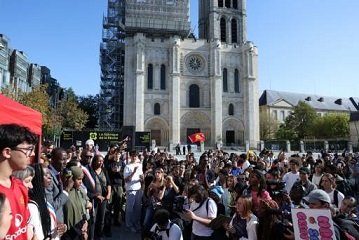
About 5,000 people, 85 per cent of them minors, have been arrested in France following days of protests by high school students over poor conditions in the country’s education system.
About 400 schools have also been shut after demonstrations, blockades, clashes with police and attacks on school facilities.
At the same time, nationwide union-led protests in support of the students are planned for Tuesday, according to a CNN report.
With about 400 schools expected to remain closed on Monday and students preparing to return to the streets, Tuesday is expected to be a major test of the movement.
The influential CGT labour union, quoted by The Associated Press, has called on workers to join demonstrations in solidarity with the students, raising the possibility of the protests expanding beyond schools and becoming a wider national mobilisation.
The government is facing the dual challenge of restoring public order and responding to the students’ complaints about inequality, overcrowding, teacher shortages and deteriorating school facilities.
The protests, which began in the Paris region in mid-September, have spread across the country, with students staging demonstrations and blocking school entrances in both major cities and smaller towns.
The unrest has also been marked by violence, including clashes with police and fires at some schools, raising concerns that the student demonstrations could turn into wider public disorder.
The demonstrations began after teachers and students mobilised against a staff shortage at a high school in Créteil, in the southeastern suburbs of Paris.
The movement subsequently spread to other schools in the Paris region and then nationwide.
Students say the education system is underfunded and overstretched, with overcrowded classrooms, inadequate facilities, teacher shortages and deteriorating school buildings.
A 15-year-old student, Kesia, who demonstrated in the Paris suburb of Pantin, said students were struggling with overcrowded classrooms and inadequate facilities.
“We are 35 per class; we don’t have enough chairs in classrooms; the one-hour lunch break is too short for everyone to get food,” she said.
Students in different parts of the country have also complained about schools becoming unbearably hot during summer and cold during winter because of poor infrastructure.
French media have shown images and videos of rats, leaking roofs, collapsed ceilings, damaged furniture and other problems in schools.
Sophie Bordy, a 50-year-old literature teacher in Paris, said the condition of schools had deteriorated considerably.
“The public needs to know that conditions for studying are no longer what they were for us,” she said. “It has deteriorated significantly.”
The students’ grievances centre largely on inequality in the education system.
They argue that students in poorer neighbourhoods do not have access to the same quality of teaching, facilities and opportunities as those in more affluent areas.
Placards displayed by some of the first protesters in Créteil included messages such as “Too many inequalities, we’re disgusted” and “Education is a right, not a privilege.”
Another read, “Sorry to bother, it’s for our future.”
Students have also criticised the length of the school day, with classes in many high schools beginning at 8 am and continuing until early evening.
One placard photographed by French newspaper Le Parisien read, “I see the teachers more than my family.”
Education spending is one of the largest items in the French government’s proposed 2027 budget, with €65.5bn earmarked for schools, compared with €63.4bn for defence.
However, students and teachers argue that the funding has not translated into adequate conditions in schools.
As the demonstrations spread, violence has increasingly become a concern.
Students in Strasbourg, eastern France, built barricades in streets filled with tear gas, while demonstrations in Lyon and other cities were more peaceful.
Authorities in several parts of France banned gatherings around schools that had been closed, but the restrictions did little to halt the demonstrations.
Police said about 2,000 people were taken into custody during the protests on Thursday alone.
The wider crackdown brought the number of arrests during the unrest to about 5,000, according to the Interior Ministry, with minors accounting for 85 per cent of those detained.
Two students also suffered serious injuries after allegedly being hit by crowd-control rounds fired by police.
French authorities, according to The Associated Press, said more than 170 students and 78 members of staff had been injured during the unrest, while hundreds of police officers had also suffered injuries.
French Justice Minister Gérald Darmanin said the situation had gone beyond student protests.
“We’ve moved from student protests to a question of public order,” he said on Friday.
Amnesty International accused French security forces of using disproportionate force against minors, including batons, tear gas and non-lethal flash-ball weapons.
The organisation called on the authorities to prioritise dialogue and de-escalation rather than the use of weapons.
The French Interior Ministry has opened three investigations into alleged police violence.
The Paris police prefecture, however, defended its officers, saying they had been confronted by people intent on provoking clashes.
Agathe Foucault, a spokesperson for the French police, said officers were required to use force only when necessary and proportionately.
The protests have also become politically charged, with politicians from the far-left France Unbowed party openly supporting the students.
France Unbowed leader, Jean-Luc Mélenchon, has accused the police of using excessive force against protesters and urged his supporters to protect students by positioning themselves between demonstrators and police.
Credit: Punchng